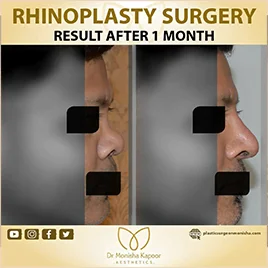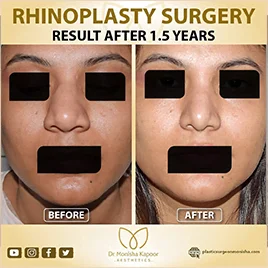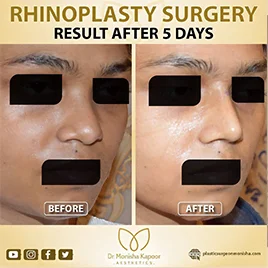

Best Rhinoplasty Surgery in Delhi
Request A Call Back
Rhinoplasty is one of the most common types of plastic surgery. A nose job is a facial cosmetic procedure, usually performed to enhance the appearance or reconstruct the nose. Commonly referred to as a “nose job,” is surgery to change the shape of your nose by modifying the bone or cartilage.
In addition to the procedure’s well-known cosmetic benefits, it can be done for medical reasons. However, rhinoplasty has evolved to have much more versatile applications, such as to improve nasal function after a traumatic injury or illness or to help with breathing problems that affect sleep and the ability to exercise.
Types of Nose Surgeries at
Dr Monisha Kapoor Aesthetics
PIEZO Rhinoplasty:
- PIEZO Rhinoplasty, also referred to as Ultrasonic rhinoplasty, is a new technology that has revolutionized the world of medicine by allowing surgeons to create more refined nasal contours and cut bone without the need to break them anymore.
- Patients benefit from significantly less pain, bruising, and swelling after Piezo Rhinoplasty, and have an overall reduced post-operative downtime.
- Ultrasonic technology opened up a new era of delicate treatment options for aesthetic bone refinement. It is a system that transforms electrical energy into ultrasound, at Dr Monisha Kapoor Aesthetics this technology is enabling us to make real “Sculpting” in the nasal bones, altering their shape and thickness as needed, and even cutting them if required, without creating any problem to other sensitive nose tissues.
Advantages of piezo over traditional rhinoplasty
- Make “sculpture” in the bones
- Form the bones just as per the patient’s desire, even in very intense asymmetries
- Thinner the nose without eventually requiring osteotomies in many cases
- If we want even more narrowing, then with the Piezo we cut the bones in order to move all of them towards the middle line
- Everything is done under direct vision and full control
- Everything is done without causing any damage to the skin, mucous membranes and other soft nose tissues
- Bumps and swelling are less
- The postoperative course is lighter and certainly painless
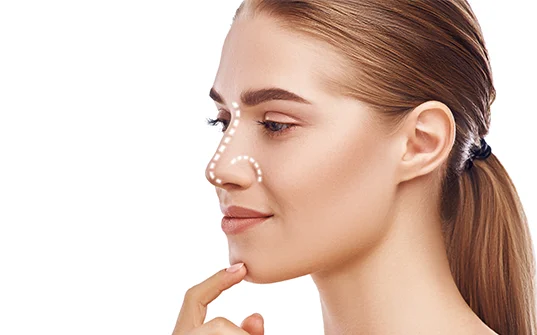
Open rhinoplasty:
- The ability to open up the nose in open rhinoplasty, allows the surgeon to see the anatomy underneath.
- Dr. Monisha Kapoor believes that given , today’s modern and detailed techniques she likes to use; the open approach is often the better choice.
- Open rhinoplasty surgery is a procedure in which the incision used to access the structures of the nose results in broad exposure of the underlying cartilage and bone.
- An open rhinoplasty involves incisions made in the narrow strip of tissue that separates the nostrils.
- An incision is made under the nasal tip between the nostrils.
- The surgeon does the reshaping procedures on the nose.
- The incision is stitched back, leaving a small scar.
- An experienced surgeon would be able to position the incision strategically to “hide” the scar in the natural contours of the nose so that the scar is less visible.
- Many patients are worried about the scar at columella but in experienced hand, this scar is barely visible.
Closed rhinoplasty
- An incision is made inside the nostril
- The surgeon does the reshaping procedures through the small incisions in the nostrils
- The incision is stitched back, leaving only a scar in the nostril that is not visible from the outside
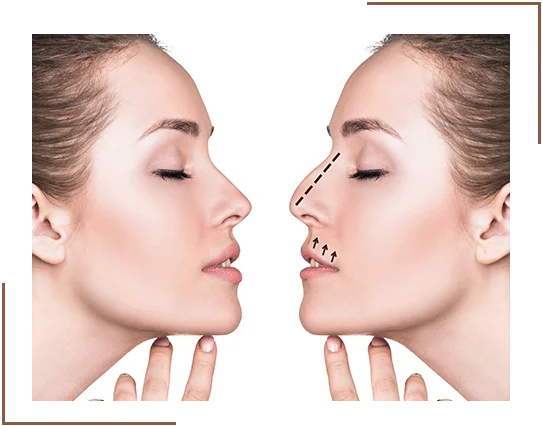
Alarplasty (Alar Reduction)
- In some patients, the nostrils can be wide or prominent. This appearance can be exaggerated on smiling.
- The nose reduction surgery involves removing some of the excess tissue from the sides of the nostrils where they attach on the cheek.
- An Alarplasty is a quick procedure but has to be done in a very conservative and precise manner. Removing too much nostril tissue can be devastating for nasal breathing and aesthetic appearance.
- Some suture techniques have been described that cinch the sides towards the centre, thus narrowing the nostrils.
Non-Surgical (Liquid) Rhinoplasty
- This procedure is ideal for people who are looking to smooth out bumps in their nose or make it look less angular but who aren’t ready for a permanent solution or are worried about the risks and recovery time involved in a traditional rhinoplasty.
- Nonsurgical rhinoplasty is also called liquid rhinoplasty.
- The procedure consists of injecting a filler ingredient, such as hyaluronic acid, underneath your skin to temporarily change the structure of your nose.
Am I a Candidate for Cosmetic Nose Surgery (rhinoplasty)?
- Their current nose makes them self-conscious or unhappy.
- They may be unhappy with the way their nose has changed as they have gotten older.
- They have a deformity which needs correcting.
- Patients who do not smoke or have shown that they can stop smoking for a prolonged period.
- Patients who have realistic aesthetic goals
- They understand what is involved with the procedure and prepare for it accordingly.
- They are aware of any medical conditions and allergies they may have and have informed their surgeon. This reduces the risk of reacting to anesthetic and medications.
Preparing for Rhinoplasty Surgery in Delhi
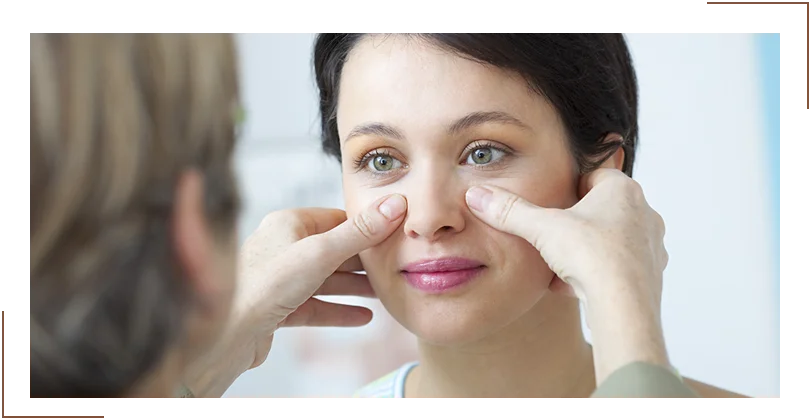
Initial evaluation for rhinoplasty at Dr Monisha Kapoor Aesthetics
Complete Procedure of Rhinoplasty in Delhi
Cosmetic nose reshaping and what it can do
- Narrowing the bridge of the nose
- Reducing the size of the nose
- Correcting the nose tip (hooked, upturned, or bulbous)
- Straightening a crooked nose
- Adjusting asymmetrical aspects to create more balance
- Smoothing out a hump or bump on the bridge
Recovery after rhinoplasty
Downtime from a nose job varies, but Dr Monisha Kapoor will likely recommend that you take a week or two off from work to get through the initial healing period. After the first couple of weeks, recovery becomes much easier.
However, it can take up to a year before you achieve the full results from your rhinoplasty procedure.
Post-operative care is very important. Unnecessary pain and the complications of infection and swelling may be minimized if the instructions are followed carefully. What does rhinoplasty look and feel like post-op after a few days, a few weeks, months, and even years? With over 15 years of experience on the job as a cosmetic surgeon, I can expand on all facets of the recovery process so that you can feel comfortable and know exactly what to expect through each phase of the recovery timeline.
- A patient can go home the same day as the surgery once fully recovered from the anesthetic. This usually takes a few hours.
- The first few days of your recovery will be the most uncomfortable and require the most rest. Relax as much as you can, ideally with your head propped up.
- After the packing has been removed, breathing through the nose is acceptable, but do not blow or sneeze through it for 7-10 days. Any sneezes should be channeled through the open mouth.
- Swelling, bruising and mild discomfort will persist for the first one to two weeks after your procedure. These effects should subside after about four to six weeks.
- You’ll probably be ready to return to work at this point, but you will have to avoid strenuous activity and heavy lifting. After a nose job, it’s normal for your skin to be extra sensitive, so you’ll have to limit your sun exposure.

Rhinoplasty Recovery Do’s and Don’ts
Do’s:
- Follow all postoperative instructions provided by Dr Monisha Kapoor Aesthetics
- Keep the head elevated
- Avoid smoking
- Avoid strenuous activity
- Get sufficient rest
Don’ts:
- Follow all postoperative instructions provided by Dr Monisha Kapoor Aesthetics
- Bump the nose
- Blow the nose or sneeze
- Smoke
- Engage in strenuous activity
Why Choose Dr Monisha Kapoor Aesthetics
When considering cosmetic nose surgery, always look for a board-certified cosmetic surgeon with specialized training and significant experience. For the best results, choose a cosmetic surgeon who is affiliated with a major medical centre, such as Dr Monisha Kapoor Aesthetics.
Make sure to ask your cosmetic surgeon about his or her credentials, training and how many procedures he or she has performed.
How much does rhinoplasty cost?
Is rhinoplasty covered by health insurance?